
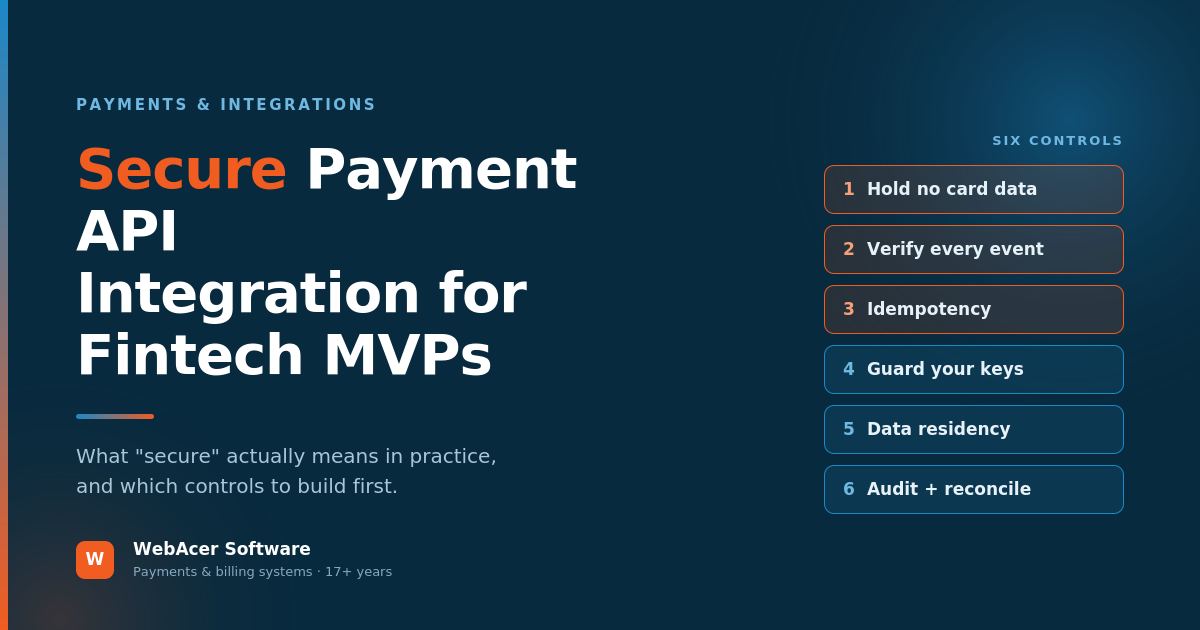
Every agency says their payment integration is secure. Almost none say what they mean by it.
For a fintech MVP the word covers six distinct things, and they get built at different times for different reasons. Knowing which is which helps you scope your build, and it tells you very quickly whether a prospective partner has done this before.
1. Never hold card data
The single biggest security decision is refusing to touch card details at all.
Use a hosted or tokenised flow, Stripe Elements, Checkout, or your provider's equivalent, so card data goes from the customer's browser straight to the provider and never reaches your servers. You store a token. If your database is ever exposed, there is nothing in it worth stealing.
This also collapses your PCI DSS obligations from a serious compliance project to a short self-assessment. Any partner proposing to handle raw card data on your infrastructure should be able to explain, in detail, why the alternative does not work for you. Usually they cannot.
2. Verify every inbound event
Webhooks are the part of your system that accepts instructions from the outside world. Treated carelessly, they are an open door.
Every provider signs their webhooks. Your endpoint must verify that signature before doing anything with the payload, and reject anything that fails. Without this, anyone who discovers your endpoint URL can post a fake "payment succeeded" event and get whatever your system grants on payment.
This takes an hour to build and is skipped surprisingly often.
3. Make every operation idempotent
Webhooks arrive twice. Requests time out after succeeding. Networks retry.
Every operation that changes money or state needs an idempotency key, so processing the same event twice produces the same result as processing it once. Enforce it in the database with a unique constraint rather than an application-level check, because two events arriving simultaneously will both pass a check and only one will survive a constraint.
Retrofitting this is painful. Build it in from the first webhook handler.
4. Treat API keys as production secrets
Live payment keys can move money. They belong in a secrets manager or your platform's environment configuration, never in the repository, never in a config file committed by accident, never in a screenshot in Slack.
Use restricted keys scoped to only the permissions the integration needs. Keep test and live credentials in genuinely separate environments. Have a rotation procedure written down before you need it, because the day you need it you will be in a hurry.
5. Protect and locate the data you do keep
You will still hold personal data: names, emails, addresses, payment metadata, subscription history. That is regulated data even though it is not card numbers.
Decide three things early. Where it lives, which matters if you serve European customers and matters absolutely if you have a data residency requirement. How long you keep it, balancing tax and audit retention against data protection minimisation. And who can read it, meaning access control on both the database and any admin interface you build.
6. Be able to prove what happened
Security is not only prevention. When something goes wrong, or an auditor asks, you need to reconstruct events.
That means an append-only log of every payment event, its source, and what your system did in response. It also means reconciliation: a scheduled job comparing your provider's records against your own database and flagging differences.
Reconciliation is usually filed under reliability rather than security, but it is how you detect anything anomalous, whether that is a missed webhook or something less innocent. It is also the control most MVPs skip, because everything looks fine at launch.
What to build now, and what can wait
MVP scope is a real constraint. Not all six carry equal urgency.
| Control | MVP | Why |
|---|---|---|
| Tokenised card flow | Build now | Retrofitting means re-architecting and expanding PCI scope |
| Webhook signature verification | Build now | An hour of work, and the alternative is an open endpoint |
| Idempotency keys | Build now | Painful to add later, cheap to add first |
| Secrets management | Build now | Nothing to retrofit, just do it properly from day one |
| Event log | Build now | You cannot recover history you never recorded |
| Reconciliation job | Soon after launch | Not needed at zero volume, essential before real volume |
| Formal retention policy | Before real customers | Needs a decision, not much code |
| Full audit and access controls | As you scale or raise | Driven by customers and investors, not by risk at day one |
The pattern is straightforward. Anything expensive to retrofit gets built now. Anything that is mostly policy or scales with volume can follow.
Judging a partner on this
You do not need to audit anyone's code. Ask two questions.
-
How will you keep card data off our servers, and what does that leave us responsible for under PCI? A specialist answers immediately and in specifics.
-
What happens if a webhook is delivered twice, or never arrives? You want to hear signature verification, idempotency, retries, and reconciliation, without prompting.
Vague answers to either are the only signal you need. We covered the broader selection criteria in more depth in How to Choose a Payments and API Integration Agency.
The thing to remember
Secure payment integration for an MVP is not about buying expensive tooling. It is about a handful of decisions that are cheap when made at the start and costly when made later.
Hold no card data. Verify every event. Make everything repeatable. Guard your keys. Know where your data lives. Keep a record you can defend.
Get those six right and you have a payment layer that will survive both your first real customer and your first serious security questionnaire.
